
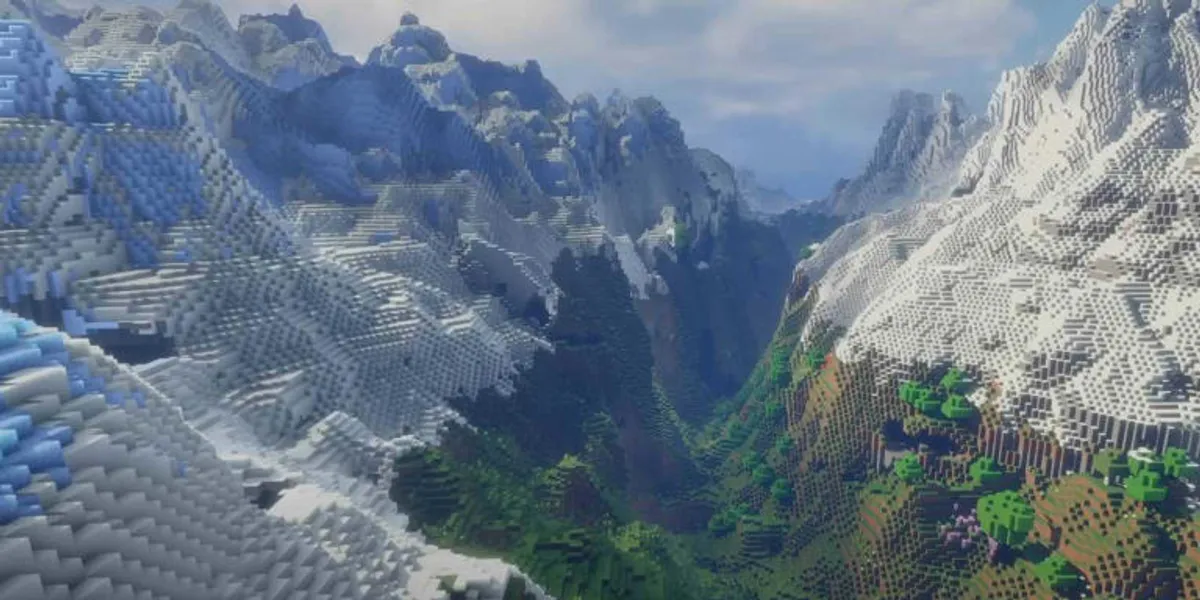
Minecraft World Generation as an Invertible Algebraic System
May 30, 2026 · 1 hr 10 min read
Written by: Weptune
[!NOTE] You can download the original PDF paper directly from this post: Download Original PDF Paper (mcseed-1.pdf).
Abstract
Minecraft Java Edition generates an effectively infinite world from a single 64-bit integer known as the world seed. Despite the apparent randomness of terrain, biomes, and structures, this process is entirely deterministic. In this work, we develop a mathematically rigorous model of Minecraft world generation, showing that all generated features are affine, pseudo-random, and ultimately invertible functions of the seed. We explain why Minecraft seed recovery is not an exploit, but a mathematical inevitability.
1. Minecraft Seeds as Mathematical Objects
1.1 The World Seed
In Minecraft Java Edition, every world is generated from a single signed 64-bit integer provided by the player or sampled uniformly at random. Internally, this value is treated as an element of the ring .
Definition 1.1 (World Seed). The world seed is the unique element from which all terrain, biomes, structures, and decorations in a Minecraft world are deterministically generated.
No additional entropy is introduced after this value is fixed.
1.2 Determinism of Minecraft World Generation
Let denote the infinite set of blocks, biomes, and structures comprising a Minecraft world. World generation can be modeled as a function:
Definition 1.2 (Determinism). Minecraft world generation is deterministic if:
This property is required for multiplayer synchronization, reproducible worlds, and save-file compatibility.
1.3 Chunks and Spatial Locality
Minecraft does not generate the world monolithically. Instead, the world is partitioned into chunks. Each chunk is a vertical column of blocks of size , indexed by integer coordinates .
Definition 1.3 (Chunk). A chunk is the restriction of the world to a fixed coordinate pair , denoted by .
Crucially, Minecraft must satisfy the locality condition:
for some deterministic function . This means that the contents of a chunk can be computed without generating any neighboring chunks.
1.4 Entropy Accounting
Initially, the system contains exactly bits of entropy.
Lemma 1.4. Let . Then:
Proof. Given a fixed seed, all subsequent steps in Minecraft world generation are deterministic and introduce no additional randomness. All apparent randomness in the world is therefore pseudo-random and fully encoded by the seed.
1.5 Observations and the Seed-Finding Problem
A player never observes the entire world. Instead, they observe finite features such as biome layouts, terrain height, village locations, or strongholds. Let denote such an observation.
Definition 1.5 (Minecraft Seed-Finding Problem). Given a finite observation , determine the seed such that:
The remainder of this paper explains why this problem typically has a unique solution and how that solution can be recovered efficiently.
2. Java Random and Minecraft’s Core RNG
2.1 Why Randomness Matters in Minecraft
Every apparent random decision in Minecraft world generation is driven by calls to a pseudo-random number generator (PRNG). Because Minecraft must be deterministic, this PRNG cannot rely on external entropy and must instead derive all randomness from the world seed.
Minecraft Java Edition uses the standard library class java.util.Random as its fundamental source of pseudo-randomness.
2.2 The Java Random Generator
Java’s Random class is based on a Linear Congruential Generator (LCG) with a 48-bit internal state.
Definition 2.1 (Java Random State). The internal state of a Java
Randominstance is an integer .
The state evolves according to the recurrence:
where the multipliers and addends are fixed LCG constants:
Remark 2.2. These constants are fixed by the Java specification and are therefore shared by every Java-based Minecraft world ever generated.
2.3 Seeding Java Random from the World Seed
Minecraft does not use the 64-bit world seed directly as the PRNG state. Instead, it derives a 48-bit internal state via a masking operation.
Definition 2.3 (Java Random Initialization). Given a world seed , Java
Randominitializes its internal state as:
This operation discards the upper 16 bits of the world seed.
Remark 2.4. As a consequence, many Minecraft subsystems operate on only 48 bits of the original 64-bit seed. This distinction is critical in seed-finding algorithms.
2.4 Affine Structure of the RNG
The LCG recurrence relation defines an affine transformation over the ring .
Proposition 2.5. The Java
Randomtransition function is bijective.
Proof. Since is odd, we have . Therefore, multiplication by is invertible modulo . This implies that the PRNG state can be evolved both forward and backward in time, a property heavily exploited in Minecraft seed recovery.
2.5 Closed-Form Expression for RNG State
Unrolling the LCG recurrence yields a closed-form expression for the -th state.
Lemma 2.6. For all :
Proof. The result follows by induction on . This equation shows that every RNG state is an affine function of the initial state , and therefore ultimately an affine function of the world seed.
2.6 Output Functions in Minecraft
Minecraft never exposes the internal RNG state directly. Instead, it consumes randomness via methods such as nextInt(n), nextFloat(), and nextDouble(). Each of these extracts high-order bits of the internal state.
Definition 2.7 (nextInt). The method
nextInt(n)computes:where is the current internal state.
Remark 2.8. Only the most significant bits of the state influence the output. The lower bits are entirely invisible at the observation level.
2.7 Entropy Leakage per RNG Call
A call to nextInt(n) partitions the state space into intervals of approximately equal size.
Proposition 2.9. A single call to
nextInt(n)leaks approximately bits of information about the RNG state.
This leakage is cumulative across successive RNG calls.
2.8 RNG Calls as World-Generation Decisions
In Minecraft world generation, RNG calls correspond to concrete in-game decisions:
- Village placement offsets
- Structure orientation
- Biome selection
- Ore vein generation
- Tree height and shape
Each such decision introduces a constraint on the internal RNG state and, by extension, on the world seed.
2.9 Relevance to Seed Finding
Because:
- Java
Randomis affine and invertible. - Its output functions induce interval constraints.
- Minecraft makes many RNG calls per chunk.
Observing world features corresponds to observing affine constraints on the world seed. This observation forms the mathematical foundation of all Minecraft seed-finding techniques.
3. ChunkSeed, PopulationSeed, and Spatial Reseeding
3.1 Why Minecraft Reseeds Its RNG
Minecraft does not generate the world using a single global stream of random numbers. Instead, it repeatedly reinitializes Java’s Random using the world seed combined with spatial coordinates. This design enforces two critical properties:
- Spatial locality: chunks can be generated independently.
- Order independence: generation order does not affect results.
These constraints force Minecraft to derive local randomness via deterministic functions of the world seed and chunk coordinates.
3.2 Chunk Coordinates
Minecraft partitions the horizontal plane into chunks indexed by integer coordinates . All terrain, biomes, and structures associated with a chunk must be derivable from the pair and the global seed alone.
3.3 ChunkSeed Construction
For most world-generation steps, Minecraft derives a chunk seed by combining the world seed with chunk coordinates using fixed odd constants.
Definition 3.1 (ChunkSeed). Let be the world seed. The chunk seed associated with coordinates is defined as:
where are fixed odd 64-bit constants.
Remark 3.2. In the Minecraft Java source, these constants are generated by calls to
Random.nextLong()and are therefore odd with overwhelming probability.
3.4 Affine Nature of Chunk Seeding
The map is affine over the ring .
Proposition 3.3. For fixed , the map is bijective.
Proof. The operation is a translation by a constant depending on . Translation in a finite ring preserves bijectivity. Thus, chunk reseeding preserves all entropy of the world seed.
3.5 PopulationSeed
After terrain height and biome layouts are computed, Minecraft performs population (placing trees, ores, vegetation, etc.). To do this, Minecraft derives a population seed from the chunk seed.
Definition 3.4 (PopulationSeed). Let be the chunk seed. The population seed is obtained by initializing Java
Randomwith:where is Java
Random’s multiplier.
The resulting PRNG stream is used exclusively for population within that chunk.
3.6 Structure Seeds and Region Partitioning
Large structures such as villages, temples, and strongholds are not placed on a per-chunk basis. Instead, Minecraft partitions the world into regions of size chunks, where depends on the structure type.
Definition 3.5 (Region Coordinates). For a chunk , the region coordinates are:
3.7 Structure Seed
Each region has an associated structure seed derived from the world seed and region coordinates.
Definition 3.6 (Structure Seed). The structure seed for region is:
where are fixed odd constants specific to the structure generator.
This seed determines whether a structure spawns in the region and, if so, its exact position.
3.8 Affine Dependence on the World Seed
Every random decision made during chunk population or structure placement is derived from a PRNG state of the form:
for known constants and .
Proposition 3.7. All Minecraft RNG states are affine functions of the world seed.
Proof. Chunk seeding is affine in . Java Random evolution is affine in its initial state. Composition of affine maps is affine.
3.9 Why Locality Does Not Hide the Seed
It is sometimes assumed that reseeding per chunk or per region obscures the world seed. Algebraically, this is false.
Theorem 3.8. Let be a finite set of chunk coordinates. The mapping:
is injective.
Proof. Each differs from by a known constant. Equality of all translated values implies equality of itself. Thus, observing multiple chunks provides multiple independent affine constraints on the same hidden seed.
3.10 Collision Analysis
Two chunk seeds collide if:
Lemma 3.9. If and are odd, then a collision occurs if and only if and .
Proof. Odd constants are invertible modulo , so the linear combination vanishes only when each term vanishes.
4. From Minecraft Features to Mathematical Constraints
4.1 What Counts as an Observation in Minecraft
In the context of Minecraft seed finding, an observation is any in-game feature whose existence, location, or shape depends on calls to Java Random. Examples include:
- The exact offset of a village within its region
- Whether a structure generates at all in a region
- The biome at a specific block position
- Terrain height at a given coordinate
- Tree height, orientation, or variant
Each such observation corresponds to one or more calls to Random.nextInt, nextFloat, or nextDouble.
4.2 Java nextInt as an Interval Constraint
Recall that Java Random maintains an internal state . A call to nextInt(n) computes .
Definition 4.1 (nextInt Constraint). If
nextInt(n)returns the value , then the internal state must satisfy:
Thus, observing a single integer output restricts the RNG state to a contiguous interval of width approximately .
4.3 Example: Village Position Inside a Region
Consider village generation. For a given region , Minecraft determines whether a village spawns and, if so, chooses its position using LCG calls to nextInt. Typically, offsets are chosen as:
where is the region size in chunks. Observing the exact village position therefore yields two independent interval constraints on the LCG state.
Proposition 4.2. A single observed village provides approximately bits of information about the LCG state.
This is why villages are extremely powerful for seed finding.
4.4 Absence of Structures as Constraints
Equally important is the absence of structures.
Definition 4.3 (Absence Constraint). If a structure does not generate in a region, then the RNG state must lie outside the interval(s) that would trigger generation.
For example, if a structure spawns only when nextInt(k) = 0, then observing no structure implies:
Remark 4.4. Absence constraints often eliminate large portions of the state space and can be as informative as presence constraints.
4.5 Biome Sampling as Repeated Constraints
Biome generation in Minecraft is performed by layered generators that repeatedly sample Java Random at different spatial scales. Observing a biome at a specific coordinate corresponds to a sequence of RNG calls whose outputs are consistent with that biome.
Proposition 4.5. A single biome observation induces multiple correlated constraints on the RNG state.
This explains why combining biome data across multiple locations rapidly narrows the set of possible seeds.
4.6 Chaining Constraints Through RNG Evolution
Let be the initial RNG state for a given chunk or region. Subsequent calls produce states . Each observation restricts a different to an interval . Collectively, these constraints define a feasible set:
4.7 From RNG State Constraints to Seed Constraints
Since every LCG state is an affine function of the world seed:
Therefore, each interval constraint on induces an interval constraint on .
Proposition 4.6. Every Minecraft observation yields a linear modular inequality on the world seed. Seed finding is therefore equivalent to solving a system of affine modular inequalities.
4.8 Geometric Interpretation
Each constraint restricts the seed to lie in a slab of . Intersecting many such slabs rapidly reduces the feasible set.
Remark 4.7. Geometrically, Minecraft seed finding is the problem of intersecting many high-dimensional slabs until only a single integer point remains.
4.9 Entropy Collapse in Practice
If the total information extracted from observations exceeds 48 bits (the size of the Java Random state), then the internal RNG state is uniquely determined. Once this occurs, recovering the full 64-bit world seed becomes straightforward.
Theorem 4.8 (Practical Entropy Collapse). Given sufficiently many structure, biome, or decoration observations, the Minecraft world seed is uniquely determined with overwhelming probability.
5. Minecraft Seed Finding as a Lattice Problem
5.1 From Constraints to Computation
The goal of Minecraft seed finding is to solve a system of modular constraints and recover the unique world seed consistent with all observations:
We can reformulate this exactly as a lattice problem over the integers.
5.2 Removing the Modulo via Lifting
Java Random LCG states evolve modulo . To work over the integers, we introduce carry variables that account for modular arithmetic wraparound.
Definition 5.1 (Lifted RNG Recurrence). Let . There exists an integer such that:
This transformation removes modular arithmetic at the cost of introducing new integer unknowns .
5.3 Minecraft RNG State Vector
Suppose we observe LCG calls during world generation (e.g. from village offsets). Define the unknown vector:
where is the initial Java Random state.
5.4 Linear System Representation
Unrolling the lifted recurrence yields:
This can be written compactly as:
where , is a known LCG offset vector, and is a lower-triangular integer matrix.
5.5 The Minecraft RNG Lattice
Definition 5.2 (Minecraft RNG Lattice). Let be the lattice generated by the columns of .
Every possible sequence of Java Random states consistent with Minecraft’s RNG rules corresponds to a lattice point in , translated by the fixed offset .
5.6 Bounding Box from Minecraft Observations
Each spatial observation yields bounds . Collectively, these bounds define an axis-aligned box:
The Minecraft seed-finding problem is now equivalent to finding lattice points in the translated intersection:
5.7 Determinant of the Minecraft RNG Lattice
The determinant of the lattice governs the density of valid LCG trajectories.
Lemma 5.4. The determinant of the Minecraft LCG lattice satisfies:
Proof. Each carry variable introduces a modular factor of , and there are such variables. Elementary column operations preserve the determinant magnitude.
5.8 Why Minecraft Seeds Become Unique
The volume of the bounding box is:
For observations based on nextInt(k_i), we have . Thus:
Theorem 5.5 (Minecraft Uniqueness Criterion). If:
then the translated intersection contains at most one point.
Proof. This is a direct application of Minkowski’s theorem to the difference body .
5.9 Interpretation in Minecraft Terms
This explains why combining observations collapses the seed space:
- A few village offsets uniquely isolate the structure seed.
- Biome layouts eliminate almost all candidates within seconds.
- Combining features collapses the 64-bit solution space rapidly because the bounding volume shrinks exponentially faster than the lattice density .
6. Algorithms Used in Practical Minecraft Seed Finders
6.1 From Theory to Tools
Having established that a unique seed must exist, seed-finding tools must solve the structured integer geometry problem: find the unique lattice point inside .
6.2 The Closest Vector Problem in Minecraft
Let denote the vector of true LCG states. Since lies near the center of the bounding box , seed finding is an instance of the Closest Vector Problem (CVP):
Definition 6.1 (Minecraft CVP Instance). Given the LCG lattice and a target vector , find minimizing .
6.3 Why CVP Is Easy in Minecraft
In general, CVP is NP-hard. However, Minecraft LCG lattices lie in an exceptionally favorable regime:
- The solution is provably unique.
- The distance from to the target lattice point is extremely small.
- All competing lattice points are separated by massive LCG gaps.
These properties dramatically simplify the problem, making it solvable in polynomial time.
6.4 Embedding CVP into SVP
Most lattice reduction libraries (like fplll) solve the Shortest Vector Problem (SVP) rather than CVP. To bridge this gap, seed-finding tools use Kannan’s embedding technique.
Definition 6.2 (Kannan Embedding for Minecraft). Let be a basis of the LCG lattice , and let be the target vector. Define the augmented basis as:
where is a large integer scaling factor.
A sufficiently short vector in the lattice generated by directly encodes the coordinates of the target closest vector.
6.5 Choice of Scaling Parameter
The scaling parameter must dominate the coordinate errors. In our LCG lattice, the errors correspond to the interval radii . In practice, tools choose on the order of the largest interval width.
Lemma 6.3. If exceeds the maximum interval radius by a constant factor, then the shortest vector of the embedded lattice corresponds to the true LCG state sequence.
6.6 Basis Conditioning and Scaling
The raw LCG lattice basis is numerically ill-conditioned: some coordinates scale like , while others are much smaller. To improve performance, diagonal scaling is applied:
The scaled basis ensures that all dimensions contribute comparably to vector length calculations during reduction.
6.7 The LLL Algorithm in Practice
The Lenstra–Lenstra–Lovász (LLL) algorithm takes an ill-conditioned basis and produces a nearly orthogonal, reduced basis in polynomial time.
Theorem 6.5 (LLL Reduction). Given a basis of dimension with entries of bits, LLL runs in time polynomial in and recovers vectors within an exponential approximation factor of optimal.
This approximation is more than sufficient to isolate the exceptionally short target CVP vector.
6.8 Why LLL Works for Minecraft
Theorem 6.6. In Minecraft seed-finding instances, LLL recovers the correct RNG state vector with overwhelming probability.
Sketch. The true solution corresponds to an exceptionally short vector due to the uniqueness condition . All competing lattice vectors are separated by distances exponential in . LLL’s approximation easily isolates the true solution.
6.9 Handling Branching Generation Logic
Minecraft world generation often includes conditional statements:
if (random.nextInt(k) == 0) { generateStructure();}This introduces branching constraints.
Proposition 6.7. Each branch corresponds to a distinct lattice instance.
In practice, seed-finding tools enumerate branches but prune them aggressively: inconsistent branches produce empty CVP feasible regions and are discarded early.
6.10 Recovering the World Seed
Once the initial state is recovered, the 48-bit world seed is trivially computed by:
Using other structures or biome observations, the upper 16 bits of the 64-bit seed are recovered through simple local check filters.
7. Why Minecraft Cannot Hide Its Seeds
7.1 Reframing Minecraft World Generation
Minecraft world generation can be viewed as an information-processing system that expands a finite 64-bit seed into an infinite world via the deterministic mapping . This mapping is injective: distinct seeds produce distinct worlds.
7.2 Minecraft as a Noiseless Information Channel
We may model generation as a communications channel:
where represents the in-game observations.
Proposition 7.1. The channel is noiseless.
Proof. Minecraft generation is deterministic. Given the seed, the generated world is uniquely determined, implying .
7.3 Entropy Conservation in Minecraft
The world seed contains exactly 64 bits of entropy. Because no external randomness is introduced during generation, this entropy must be conserved throughout all stages of world creation.
Theorem 7.2 (Entropy Conservation). Let . Then:
Proof. Since is a deterministic function of , we have . The result follows directly from the definition of mutual information.
Every observed Minecraft feature leaks information about the seed.
7.4 Why More Complexity Does Not Help
A common intuition is that adding more layers of generation (more noise functions, more biome layers, more decorators) should obscure the seed. Mathematically, this is false.
Proposition 7.3. Adding deterministic computation cannot reduce information leakage about the seed.
Proof. Deterministic transformations preserve mutual information. Additional computation merely re-encodes existing entropy; it cannot destroy it.
In fact, additional complexity often increases leakage by introducing more observable features.
7.5 Multiple RNGs Do Not Improve Security
Modern versions of Minecraft use multiple pseudo-random generators for different subsystems (terrain, structures, biomes, etc.).
Definition 7.4 (Coupled RNG System). A coupled RNG system consists of multiple PRNGs whose initial states are affine functions of the same world seed.
Theorem 7.5. Coupled RNG systems leak information additively.
Proof. Each PRNG produces independent affine constraints on the seed. Observing multiple subsystems increases total mutual information.
7.6 Why Cryptographic RNGs Are Impractical
One might attempt to prevent seed recovery by replacing Java Random with a cryptographic PRNG (like AES-CTR). While this would make inversion computationally expensive, it would introduce severe drawbacks:
- Severe performance degradation (generating millions of blocks per second).
- Platform-dependent compiler optimization issues.
- Fundamentally breaking simple, highly performant LCG coordinate seeding.
Moreover, cryptographic PRNGs merely trade invertibility for computational hardness; they do not eliminate the physical information leakage.
7.7 True Randomness Breaks Minecraft
The only way to prevent seed recovery entirely is to inject true, nondeterministic randomness (like server-time entropy) during generation.
Theorem 7.7. Injecting nondeterministic entropy breaks reproducibility.
Proof. If generation depends on external randomness, then identical seeds can produce different worlds, violating Minecraft’s core guarantee of multiplayer synchronization and reproducible worlds.
Thus, unrecoverable seeds and deterministic generation are mutually exclusive.
8. Conclusion
Minecraft seed finding is not a vulnerability, exploit, or oversight. It is an inevitable consequence of deterministic procedural generation combined with rich observable structure. Any system that satisfies Minecraft’s design goals (speed, determinism, and exact reproducibility) must, in principle, admit algebraic inversion.