hi ^-^ i solve a lot of math, and wanted a place where i document fun, challenging, and elegant mathematical problems i’ve solved over time
2015 AMC 12B #25
Problem
A bee starts flying from point P0. She flies 1 inch due east to point P1. For j≥1, once the bee reaches Pj, she turns 30∘ counterclockwise and then flies j+1 inches straight to point Pj+1. When the bee reaches P2016, she is exactly ab+cd inches away from P0, where a, b, c, and d are positive integers and b and d are square-free. Find a+b+c+d.
Solution
Modeling the Flight with Complex Numbers
Represent the plane as the complex plane and place P0 at the origin.
Let
ω=eiπ/6.
Since the bee turns 30∘ after each segment, the k-th flight segment has:
Length k
Direction angle (k−1)⋅30∘
Thus the displacement from Pk−1 to Pk is
kωk−1.
Therefore, the position of P2016 relative to P0 is
S=k=1∑2016kωk−1.
Our goal is to compute ∣S∣.
Exploiting the Fact that ω12=1
Since
ω12=e2πi=1,
and
2016=168⋅12,
we group the sum into 168 blocks of 12 consecutive terms:
S=m=0∑167t=1∑12(12m+t)ωt−1.
Expanding,
S=m=0∑167(12mt=1∑12ωt−1+t=1∑12tωt−1).
Because ω is a primitive 12th root of unity,
t=1∑12ωt−1=1+ω+ω2+⋯+ω11=0.
Hence all terms involving 12m vanish, giving
S=168t=1∑12tωt−1.
Let
C=t=1∑12tωt−1.
Then
S=168C.
Evaluating the Root-of-Unity Sum
Consider the finite geometric series
1+x+x2+⋯+x11=1−x1−x12.
Differentiate both sides:
t=1∑12txt−1=(1−x)2−12x11(1−x)+(1−x12).
Substituting x=ω and using ω12=1 gives
C=(1−ω)2−12ω11(1−ω)=−1−ω12ω11.
Since ω11=ω−1,
C=−1−ω12ω−1.
Multiplying numerator and denominator by ω,
C=−ω−ω212.
Factoring ω from the denominator,
C=−ω(1−ω)12=−1−ω12.
Therefore,
S=168(−1−ω12)=−1−ω2016.
Computing 1−ω1
Since
ω=cos30∘+isin30∘=23+2i,
we have
1−ω=22−3−2i.
A standard identity gives
1−eiθ1=21+2icot(2θ).
Using θ=6π,
1−ω1=21+2icot15∘.
Since
cot15∘=2+3,
it follows that
1−ω1=21+2i(2+3).
Therefore,
S=−2016(21+2i(2+3))=−1008−1008(2+3)i.
Finding the Distance from the Origin
The distance from P0 to P2016 is
∣S∣=10081+(2+3)2.
Compute the quantity inside the square root:
1+(2+3)2=1+4+43+3=8+43.
Factor:
8+43=4(2+3).
Hence
∣S∣=20162+3.
Use the identity
2+3=2(3+1)2.
Thus
2+3=23+1=26+2.
Substituting,
∣S∣=2016⋅26+2=10086+10082.
Therefore,
a=1008,b=6,c=1008,d=2.
Computing the Requested Sum
a+b+c+d=1008+6+1008+2=2024.
Final Answer:2024
2004 AIME I #12
Problem
Let S be the set of ordered pairs (x,y) such that 0<x≤1, 0<y≤1, and both
⌊log2(x1)⌋
and
⌊log5(y1)⌋
are even integers. Given that the area of the graph of S is nm, where m and n are relatively prime positive integers, find m+n.
Solution
Determining the Valid Values of x
Suppose
⌊log2(x1)⌋=2k
for some integer k≥0.
By the definition of the floor function,
2k≤log2(x1)<2k+1.
Exponentiating base 2 gives
22k≤x1<22k+1.
Taking reciprocals reverses the inequalities:
2−(2k+1)<x≤2−2k.
Therefore, for each k≥0, the valid interval for x is
(2−(2k+1),2−2k].
The length of this interval is
2−2k−2−(2k+1)=2−(2k+1).
Hence the total measure of all valid x-values is
k=0∑∞2−(2k+1)=21k=0∑∞(41)k.
Using the geometric series formula,
21⋅1−411=21⋅34=32.
Thus the total valid length in the x-direction is
32.
Determining the Valid Values of y
Similarly, suppose
⌊log5(y1)⌋=2m
for some integer m≥0.
Then
2m≤log5(y1)<2m+1.
Exponentiating base 5 yields
52m≤y1<52m+1.
Taking reciprocals,
5−(2m+1)<y≤5−2m.
The length of this interval is
5−2m−5−(2m+1)=4⋅5−(2m+1).
Therefore the total measure of all valid y-values is
m=0∑∞4⋅5−(2m+1)=54m=0∑∞(251)m.
Again applying the geometric series formula,
54⋅1−2511=54⋅2425=65.
Thus the total valid length in the y-direction is
65.
Computing the Area of S
The conditions on x and y are independent, so the area of S is the product of the valid lengths in the two directions:
Area(S)=32⋅65=1810=95.
Hence
nm=95,
so
m=5,n=9.
Computing m+n
Therefore,
m+n=5+9=14.
Final Answer:14
2010 AIME I #2
Problem
For a positive integer n, let θ(n) denote the number of integers 0<x<2010 such that
x2−n
is divisible by 2010.
Determine the remainder when
n=0∑2009n⋅θ(n)
is divided by 2010.
Solution
Interpreting the Sum
For each integer x with 0<x<2010, there is exactly one residue
n∈{0,1,…,2009}
such that
x2≡n(mod2010).
The value θ(n) counts how many integers x produce the residue n.
Therefore, each x contributes its corresponding residue n exactly once to the sum
n=0∑2009n⋅θ(n).
Hence
n=0∑2009n⋅θ(n)=x=1∑2009(x2mod2010).
Reducing Modulo 2010
Since
x2mod2010≡x2(mod2010),
we have
n=0∑2009n⋅θ(n)≡x=1∑2009x2(mod2010).
Thus we only need to compute
x=1∑2009x2.
Using the sum-of-squares formula,
x=1∑2009x2=62009⋅2010⋅4019.
Since
62010=335,
this becomes
2009⋅335⋅4019.
Computing the Remainder
Working modulo 2010,
2009≡−1(mod2010)
and
4019≡−1(mod2010).
Therefore,
2009⋅335⋅4019≡(−1)⋅335⋅(−1)=335(mod2010).
So the required remainder is
335.
Final Answer:335
2025 AMC 12A #1
Problem
Solution
Counting Lattice Points
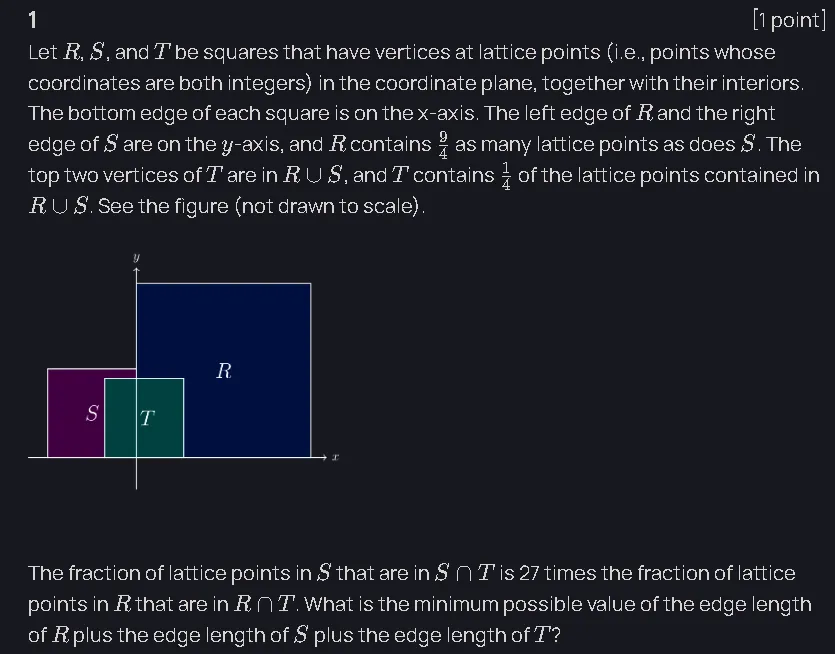
Let the side lengths of R, S, and T be r, s, and t, respectively.
Since each square is aligned with the lattice, a square of side length m contains
(m+1)2
lattice points.
Thus,
N(R)=(r+1)2,N(S)=(s+1)2.
We are given
(r+1)2=49(s+1)2.
Since r+1 and s+1 are integers,
r+1=3k,s+1=2k
for some positive integer k.
Hence
r=3k−1,s=2k−1.
Counting Points in R∪S
Since R and S meet along the y-axis and r>s, their intersection contains exactly
s+1
lattice points.
Therefore
N(R∪S)=(r+1)2+(s+1)2−(s+1).
Substituting r+1=3k and s+1=2k gives
N(R∪S)=9k2+4k2−2k=13k2−2k.
Since T contains one-fourth of the lattice points in R∪S,
(t+1)2=413k2−2k.
Using the Fraction Condition
Let x1 be the width of S∩T and x2 the width of R∩T.
Then
t=x1+x2.
Since T has height t, the intersections contain
N(S∩T)=(x1+1)(t+1),
and
N(R∩T)=(x2+1)(t+1)
lattice points.
The given ratio becomes
(s+1)2(x1+1)(t+1)=27⋅(r+1)2(x2+1)(t+1).
Using
(r+1)2=49(s+1)2,
we obtain
x1+1=12(x2+1).
Hence
x1=12x2+11.
Since
t=x1+x2,
it follows that
t=13x2+11.
Let
X=13x2+12=t+1.
Deriving a Pell Equation
Since
(t+1)2=413k2−2k,
and k=2s+1, letting
M=s+1
gives
4X2=413M2−4M.
Multiplying by 4,
16X2=13M2−4M.
Rearranging,
13M2−4M−16X2=0.
Multiply by 13:
169M2−52M−208X2=0.
Complete the square:
(13M−2)2−4−208X2=0.
Thus
(13M−2)2−208X2=4.
Dividing by 4 gives
(213M−2)2−52X2=1.
Let
Y=213M−2.
Then
Y2−52X2=1.
This is a Pell equation.
Solving the Pell Equation
The fundamental positive solution of
Y2−52X2=1
is
(Y,X)=(649,90).
Since
X=t+1,
we obtain
t=89.
Also,
Y=213M−2=649,
so
13M−2=1298,
and therefore
M=100.
Hence
s=M−1=99.
Since
r+1=23(s+1),
we have
r+1=150,
so
r=149.
Computing the Sum
Therefore
r+s+t=149+99+89=337.
Final Answer:337
HMMT 2025 Problem 3
Problem
A polynomial P(x) is a base-n polynomial if it is of the form
adxd+ad−1xd−1+⋯+a1x+a0,
where each ai is an integer between 0 and n−1 inclusive and ad>0.
Find the largest positive integer n such that for any real number c, there exists at most one base-n polynomial P(x) for which
P(2+3)=c.
Solution
Reformulating the Uniqueness Condition
Let
α=2+3.
Suppose two distinct base-n polynomials P(x) and Q(x) satisfy
P(α)=Q(α).
Then their difference
D(x)=P(x)−Q(x)
is a nonzero polynomial satisfying
D(α)=0.
Since the coefficients of P and Q lie in
{0,1,…,n−1},
the coefficients of D all lie in
[−(n−1),n−1].
Therefore uniqueness holds exactly when every nonzero integer polynomial vanishing at α has at least one coefficient whose absolute value is at least n.
Our task is therefore to determine the smallest possible value of
max∣di∣
among all nonzero integer polynomials
D(x)
satisfying
D(α)=0.
Finding the Minimal Polynomial of α
We compute:
α2=(2+3)2=5+26.
Hence
α2−5=26.
Squaring again gives
(α2−5)2=24.
Expanding,
α4−10α2+25=24,
so
α4−10α2+1=0.
Thus the minimal polynomial of α is
m(x)=x4−10x2+1.
Any integer polynomial vanishing at α must therefore be a multiple of m(x).
Producing a Small Multiple
Consider
(x2+1)m(x).
Multiplying,
(x2+1)(x4−10x2+1)=x6−9x4−9x2+1.
The coefficients are
1,0,−9,0,−9,0,1.
Therefore there exists a nonzero polynomial vanishing at α whose coefficients all have absolute value at most 9.
Consequently, uniqueness fails for
n=10,
because the coefficients lie in
[−9,9].
Thus
n≤9.
Showing That 9 Is Best Possible
We now prove that every nonzero multiple of
m(x)=x4−10x2+1
has some coefficient whose absolute value is at least 9.
Let
Q(x)=m(x)G(x),
where
G(x)=∑gixi
is a nonzero integer polynomial.
Let
M=max∣gi∣.
Choose an index k such that
∣gk∣=M.
The coefficient of xk+2 in Q(x) equals
qk+2=gk+2−10gk+gk−2.
Therefore
∣qk+2∣≥10∣gk∣−∣gk+2∣−∣gk−2∣≥10M−M−M=8M.
Since M≥1,
∣qk+2∣≥8.
If every coefficient of Q had absolute value at most 8, equality would have to hold throughout.
That forces
∣gk+2∣=∣gk−2∣=M
and all three terms must have the same sign.
Repeating the argument shows that infinitely many coefficients of G would have magnitude M, impossible because G has finite degree.
Hence no nonzero multiple of m(x) can have all coefficients bounded by 8.
Therefore every nonzero polynomial vanishing at α has a coefficient with absolute value at least
9.
Finishing the Argument
We have shown:
There exists a nonzero polynomial vanishing at α with all coefficients bounded by 9.
No nonzero polynomial vanishing at α can have all coefficients bounded by 8.
Therefore the smallest possible coefficient bound is exactly
9.
Thus uniqueness holds for base-9 polynomials and fails for base-10 polynomials.